
Aviation Turbine Fuel (ATF) prices have more than doubled to a record high, impacting airlines and consumers, while commercial LPG rates also see a significant increase.
Infosys Q4 results beat estimates, but weak FY27 guidance triggers cautious brokerage outlook and target price cuts. Should investors worry?

A lesson for India is to clearly define objectives beforehand, so that the adversary or other parties do not attempt to mitigate them midway.

Gold prices experienced a significant decline in futures trading due to uncertainty surrounding geopolitical tensions in West Asia and conflicting statements regarding the conflict. Investors are also awaiting key macroeconomic data for further direction on interest rate cuts.

The United States military has intercepted and destroyed two Iranian attack drones that posed an immediate hazard to commercial shipping lanes in the Strait of Hormuz, according to an official statement by the US Central Command late Saturday.

Fast-moving consumer goods (FMCG) companies like Dabur India and Marico anticipate high single-digit growth in Q4FY26, driven by strong domestic demand in India, which is helping to offset the negative impact of geopolitical conflicts in West Asia on their international businesses.
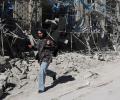
India has relocated the majority of its students from Tehran due to the escalating conflict in West Asia. The Indian embassy has arranged for their transportation, food, and accommodation outside of Tehran. An advisory remains in place for other Indian nationals in Iran to stay indoors and exercise caution.

The Reserve Bank of India (RBI) has projected a 6.9 per cent GDP growth for the current financial year, citing concerns over commodity prices and supply chain disruptions stemming from the West Asia crisis.

India's services sector growth reached a five-month high in April, with the HSBC India Services PMI Business Activity Index rising to 58.8, primarily driven by robust domestic demand and a shift from international to local suppliers amidst the West Asia crisis.

Tensions in West Asia have dramatically escalated as Israel launched targeted military operations against Iran, triggering widespread blasts across strategic cities, following earlier Iranian projectile attacks on Israel.

India has emerged as the most impacted market within emerging economies, experiencing $3.7 billion in outflows over the past three weeks, matching the total outflows from the entire emerging market basket, as global equity funds turn negative for the first time since January 2026 due to escalating geopolitical tensions.

The Reserve Bank of India (RBI) has debunked reports of gold sales, stating that its physical stock of gold remains unchanged at 880.52 tonnes, countering claims of selling approximately USD 12 billion to protect foreign-currency reserves.

Iran's representative in India, Abdul Majeed Hakeem Ilahi, describes the ongoing tensions between Iran and the US-Israel alliance as a state of 'no war, no peace,' calling for an immediate halt to the conflict and questioning the lack of pressure on the US and Israel to cease aggression.

The Central government has assured the Bombay High Court that it is taking steps to address the LPG shortage caused by the conflict in West Asia. The court accepted the submission and disposed of a petition filed by LPG distributors.

Jewellers in Lucknow protest Prime Minister Modi's appeal to defer gold purchases for a year amid the West Asia crisis, fearing significant business losses and economic hardship for those involved in the trade.

Tata Sons Chairman N Chandrasekaran addressed Air India employees, acknowledging the airline's challenging phase while reaffirming the Tata Group's commitment to its long-term transformation, focusing on service quality, safety, and operational improvements.

Crude oil prices surged over 3% in futures trade after US President Donald Trump expressed doubts about the Iran ceasefire, reigniting fears of supply disruptions from West Asia and pushing Brent crude above USD 107 per barrel.

Dabur India's stock has fallen over 17 per cent since the start of the Iran war, driven by concerns over a weak monsoon, the West Asian crisis, and rising input costs, which are expected to impact the company's revenues and margins, particularly affecting its significant rural sales and international markets.

India's fertiliser subsidy bill for the current financial year (FY27) is projected to increase by approximately 20% due to surging global prices, primarily driven by the West Asia crisis, a senior official confirmed. Despite this, retail prices for urea and di-ammonium phosphate (DAP) will remain unchanged, ensuring adequate supply for the kharif season.

The ongoing Iran-US conflict is casting a shadow over global cricket, potentially disrupting the IPL 2026 due to travel disruptions and logistical challenges.

Indian equity benchmark indices Sensex and Nifty experienced a significant tumble in early trade, with the Sensex tanking nearly 700 points, driven by uncertainty surrounding US-Iran negotiations, a fresh spike in crude oil prices, and persistent foreign fund outflows.

Fitch Ratings on Friday said persistently higher oil prices could cause India's retail inflation to rise faster than the expected gradual pace, and lead to a slowdown in economic growth in the first half of financial year 2026-27 (FY27).

Calling such reports baseless, Finance Minister Nirmala Sitharaman said there was no such move under consideration.

Indian markets on Dalal Street rallied sharply as easing tensions in the US-Iran conflict and stable oil prices boosted sentiment. Track Nifty 50 and BSE Sensex performance and key global triggers.
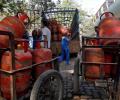
Domestic cooking gas (LPG) prices have increased by Rs 29 per cylinder, marking the second hike in three months due to rising global energy costs. This follows broader fuel price increases for petrol, diesel, and CNG, with state-owned retailers still incurring significant losses despite the revisions.
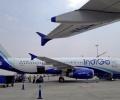
IndiGo airline will face near-term pressure on profitability from rising fuel prices following the escalation of conflict in West Asia, though it is likely to pass on higher costs to passengers over time because its ticket booking cycle is relatively short, according to a report by Moody's Ratings.

High-level peace talks between the US and Iran, facilitated by Pakistan, aim to de-escalate the conflict in West Asia and potentially reshape regional stability.

The Ministry of External Affairs informed a parliamentary committee that nearly 1,000 Indians remain in Iran amidst the West Asia conflict, and 23,000 students in the Gulf region missed CBSE exams due to the turmoil.

Heartbreaking scenes unfolded in Minab, Iran, as mourners gathered to bid farewell to the victims of the Israeli strike on a school on February 28, 2026.

India's economy registered a robust 7.7 per cent growth in the fiscal year 2025-26, an increase from 7.1 per cent in the previous year, with the January-March quarter alone seeing a 7.8 per cent expansion.

Much will depend on how the protagonists use the current interlude to work proactively for the beginning of a durable settlement or, on the contrary, prepare for a new round of escalation, points out Ambassador M K Bhadrakumar.

Indian stock markets are set to be influenced by ongoing developments in the US-Iran conflict, fluctuations in crude oil prices, and the latest quarterly earnings reports from major corporates, with foreign investor activity also playing a crucial role.

A downsizing in the prime minister's convoy was implemented in his recent domestic visits, official sources said.

'The West Asia or the Gulf crisis has shown that what we develop as national infrastructure when things are not as bad as they could be, we forget to plan for adversities.'

Indian companies, however, are now paying a premium of $6-$7 a barrel for Russian oil, compared with discounts of $8-$10 a barrel before the start of the conflict.

Foreign brokerages have started to cut their year-end targets for the Nifty 50 index amid the ongoing West Asia conflict.

In April alone, they snapped up shares worth Rs 19,664 crore, recording their biggest buy since October 2024.

India's peak power demand is projected to hit 270 GW this summer, surpassing last year's record of 250 GW.

Nobody takes Pakistan seriously and therefore Pakistan's sudden mediating with almost immediate results of a ceasefire seems more contrived than real, points out Vice Admiral Biswajit Dasgupta (retd).

The Indian rupee depreciated by 32 paise to close at 92.83 against the US dollar, influenced by escalating global tensions, particularly the US-Iran conflict, and the deadline for the RBI's instructions to banks to curb overnight positions.
